

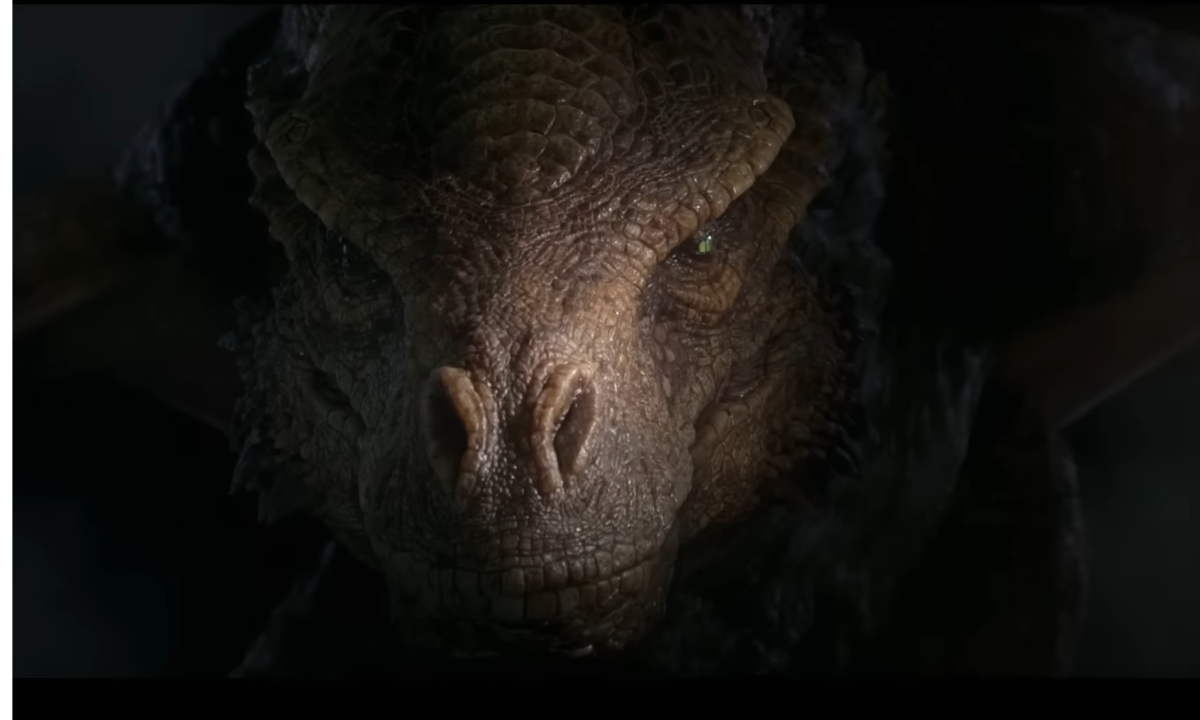
House of the Dragon can make a dragon battle feel brutally physical: riders are thrown sideways, wings cut through clouds, fire changes the light around them, and the camera seems to be struggling to keep up. But on set, the actors aren’t sitting on anything remotely resembling VhagAar, Caraxes or Meleys (dragons).
So how House of the Dragon filmed dragon scenes is almost as interesting as the battles themselves. The answer isn’t simply “CGI.” HBO’s production combines mechanical dragon rigs, motion-controlled cameras, LED environments, wind and lighting effects, and enormous amounts of visual-effects work. The real trick is making all of those separate pieces feel as though they happened at the same time, thousands of feet above Westeros.
How House of the Dragon Filmed Dragon Scenes With a Mechanical ‘Buck’
When an actor climbs onto a dragon in the finished episode, they’re actually riding a machine known as a buck.
The buck is a custom mechanical rig built by the special-effects team. Before filming, the VFX department works out the dragon’s flight path during previsualization. That movement can then be programmed into the rig, allowing it to pitch, tilt and move underneath the actor in ways that correspond with what the digital dragon will eventually do.
That’s an important distinction when looking at how actors ride dragons in House of the Dragon. They aren’t simply sitting on a stationary saddle and pretending to be shaken around.
For the huge Rook’s Rest battle, for example, the production needed the riders to appear as if their dragons were banking, diving and colliding at tremendous speed.
The actors were secured to bucks mounted on motion-controlled bases, while wind machines and lighting helped create the physical conditions of flying through the sky.That gives the performance something CGI alone can’t provide: actual resistance.
Also Read: Why Christopher Nolan Refused CGI for The Odyssey Despite a $250M Budget ?
The LED Volume Does Something You Might Not Expect
The next piece of the illusion is the LED Volume.
For some dragon-riding work, the production surrounded the performers with large LED screens displaying animated skies. But cinematographer Vanja Černjul revealed an interesting detail about the setup: those screens weren’t necessarily being used as the finished background viewers would see.
They were being used as dynamic lighting sources.
Imagine an actor flying from bright sunlight into cloud cover. The light hitting their face, costume and dragon saddle needs to change accordingly. If that lighting doesn’t correspond with the digital environment added later, the composite can immediately feel artificial.
The LED screens allowed the lighting around the performer to respond to the virtual sky.
Černjul explained that some material was even captured with different lighting conditions so the production could later match it to footage shot on location.
That’s one reason behind the scenes House of the Dragon VFX is more complicated than replacing a blue screen with a fantasy landscape.
Even the Camera Has to Pretend It’s Riding a Dragon
There’s another problem.
You can shake the actor. You can create wind. You can change the lighting.
But what about the camera?
If the rider is supposedly being hurled around on a dragon while the camera moves with perfect mechanical smoothness, something subconsciously feels wrong.
One challenge with dragon-riding scenes is making the camera feel as though it’s moving through the air alongside the rider. The production has experimented with motion-controlled and remotely operated cameras to make those movements feel less mechanically perfect and more reactive.
Černjul’s solution was wonderfully low-tech compared with everything else involved.
The operator controlled the remote camera using a shoulder-mounted system and Černjul eventually had the operator stand on a BOSU balance ball. The instability introduced tiny imperfections into the camera movement, helping it react more like a handheld camera being jostled through the air.
It’s a small detail, but it illustrates what makes these sequences convincing: sometimes realism comes from deliberately making sophisticated technology behave a little less perfectly.
How the Dragons Come to Life in Post-Production
Of course, the enormous creature still isn’t there. That’s where House of the Dragon visual effects teams take over.
The actors, mechanical rigs, camera movement and interactive lighting provide the physical foundation. Digital artists then have to create the dragons themselves and integrate the photographed material into environments that can include skies, landscapes, fire, smoke and other dragons.
The scale of that work is enormous. MPC says it produced more than 900 VFX shots for Season 1 alone, including work on dragons such as Caraxes, Meleys, Seasmoke, Vermax and Sunfyre.
Some sequences were overwhelmingly digital; MPC says much of an Episode 3 nighttime battle involving Caraxes consisted of fully CG shots.
The Dragonpit sequence involving Vermax presents another good example of how House of the Dragon dragons are made. It was filmed in a 360-degree blue-screen environment, while artists digitally recreated the enormous Dragonpit around the performers.
In other words, there isn’t one technique responsible for the dragons.
Why the Actors’ Performances Still Matter
Strip away the finished House of the Dragon visual effects, and the job becomes surprisingly strange.
An actor may be strapped to a mechanical machine, surrounded by screens, blasted with artificial wind and asked to react to a creature, enemy or fireball that doesn’t physically exist.
Tom Glynn-Carney, who plays Aegon II Targaryen, has described the dragon-riding process as chaotic. For the Rook’s Rest material, however, the surrounding technology also gave him visual information to react to, including approaching fire rather than requiring every element to exist solely in his imagination.
That interaction between performer and technology is crucial. The dragon can be photorealistic, but if the rider doesn’t appear frightened by a dive or thrown by a sudden turn, the illusion falls apart.
The Dragons Are CGI. The Performance Isn’t.
Perhaps that’s the most interesting answer to how House of the Dragon filmed dragon scenes.
The dragons themselves may ultimately be digital, but much of what sells their weight isn’t.
The rider is really moving. Wind is really hitting the actor. Lighting is changing around them. The camera is deliberately being made unstable. The mechanical buck is following movements planned around the eventual dragon animation.
Then CGI completes an illusion that has already been carefully constructed on set.
That’s why looking at raw House of the Dragon VFX footage can be so jarring. What appears on screen as a Targaryen desperately clinging to a dragon hundreds of feet above Westeros began with an actor strapped to a machine in a studio and a production team working very hard to make that machine feel alive.
Featured Image: Screenshot House Of Dragons YoutTube Trailer