

When news broke that Christopher Nolan’s The Odyssey was becoming a reality, everybody knew it was going to be massive.. But nobody expected it to be this unhinged.
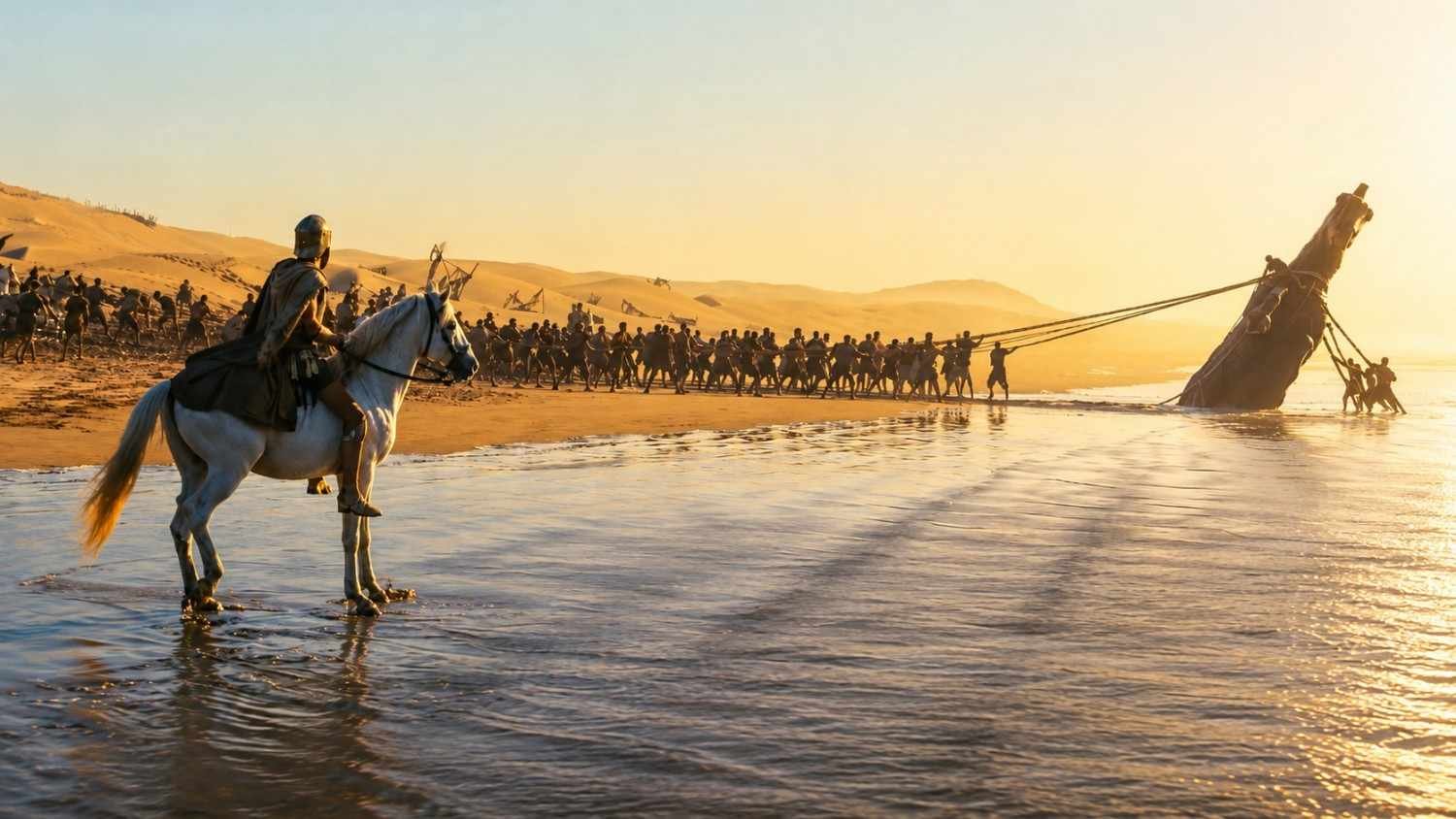
The guy spent over $250 million. He built a full-sized Trojan horse, dragged it out into the actual ocean, and just let the tide beat the hell out of it.
No green screens. No digital crowds. No CGI water tanks. Just real actors, on real wooden ships, throwing up in real storms.
Matt Damon put it best: “It was the hardest movie I’ve ever done by far. Not even close.”
And coming from a guy who got stranded on Mars and chased through South Africa, that’s saying something.
How Christopher Nolan’s The Odyssey Was Built at Sea
Most Hollywood directors today would shoot an ocean epic inside an air-conditioned studio in Atlanta. You put the actors in front of a giant LED screen, hand them a plastic prop, and let the visual effects team handle the rest.
Nolan doesn’t work like that.
For the Trojan Horse scene, he didn’t render a single piece of wood on a computer. He had his crew build a massive, full-scale horse right on the beach, anchored it into the sand, and waited for the tide to come in half-submerging it.
Fun fact: Nolan actually wanted this exact shot 20 years ago when he was considered to direct Troy back in 2004. He had to wait two decades and command a quarter-billion-dollar budget to finally pull it off.
Then there’s the Cyclops.
Instead of hiring a motion-capture actor and painting him blue in post-production, the creature team built an actual animatronic puppet. It was a massive, clanking, breathing piece of machinery. When the cast looked terrified on set, they weren’t acting against a tennis ball on a stick. They were standing inches away from a giant mechanical monster.
Even the crowds were real. Nolan brought in thousands of actual extras in heavy armor to fill out the siege scenes.
The crew couldn’t have planned what happened next, though. As cameras rolled on Odysseus’ ship cutting through open waters, a pod of wild dolphins suddenly appeared right beside the boat. No visual-effects supervisor, no CGI team—just remarkable, unscripted timing caught on real film.
Why the Cameras Made Acting Almost Impossible
Shooting the whole movie on 15/70mm IMAX sounds great on a movie poster. On set? It’s a logistical nightmare.
First off, IMAX cameras are huge. They look like industrial refrigerators. When the camera crew moved in close for an emotional dialogue scene, the body of the camera was so wide it completely blocked the other actor’s face.
Imagine trying to deliver a heartbreaking monologue about missing your home, but instead of looking into your co-star’s eyes, you’re staring directly into a giant piece of metal.
To fix it, the crew had to rig up a weird, low-tech mirror hack on set. They placed small mirrors near the lens so actors could look at a reflection of each other while delivering their lines.
Then there was the noise issue.
IMAX cameras don’t whisper. They roar. The mechanism pulling that heavy 70mm film through the body sounds like a lawnmower starting up. In the past, you could never shoot quiet, intimate dialogue scenes on IMAX because the camera motor would completely drown out the audio.
Nolan literally had to work with IMAX engineers to invent soundproof, insulated housings—basically heavy, padded coats for the camera—just so they could capture whisper-level audio without ruining the track.
11 Miles of Film, 530 Pounds, and Only 41 Theaters
The technical stats on this reel are borderline ridiculous:
- 3 minutes: That’s all the footage a single IMAX film magazine can hold before you have to stop and reload.
- 172 minutes: The final runtime. That is just eight minutes shy of the absolute physical limit of what an IMAX projection platter can hold before the film spills off the edge.
- 2 million feet: The amount of physical film exposed over the 91-day shoot.
- 530 pounds: How much a single print of the movie weighs.
When you ship The Odyssey to a theater, it doesn’t arrive as a digital file or a hard drive. It arrives in massive steel crates containing 11 miles of physical film stock.
And get this: the final cut wasn’t compiled on a computer. The master negative was physically cut and glued together by hand at FotoKem in Burbank—literally the last processing lab on Earth capable of doing it.
Because the format is so ancient and demanding, only 41 theaters in the entire world can actually project the film in its true 15/70mm format. If you aren’t near one of those 41 screens, you’re watching a digital conversion.
Is It Excessive? Absolutely.
You could argue that spending $250 million to drag 500-pound film reels across the world is pure megalomania. Why go through the agony of shooting in real ocean storms when computers can simulate water perfectly fine?
Because you can tell the difference.
When you watch Matt Damon wrestling with real ocean swells on an actual wooden boat, there’s a raw, unpredictable tension that no algorithm or graphics card can replicate. Christopher Nolan’s The Odyssey isn’t just another blockbuster. It’s an attempt to prove that practical filmmaking still matters, even if it takes 11 miles of hand-glued film to keep it alive.
Featured Image: Screenshot from “The Odyssey” (2026) Trailer / Universal Pictures
1 thought on “Why Christopher Nolan Refused CGI for The Odyssey Despite a $250M Budget ?”