

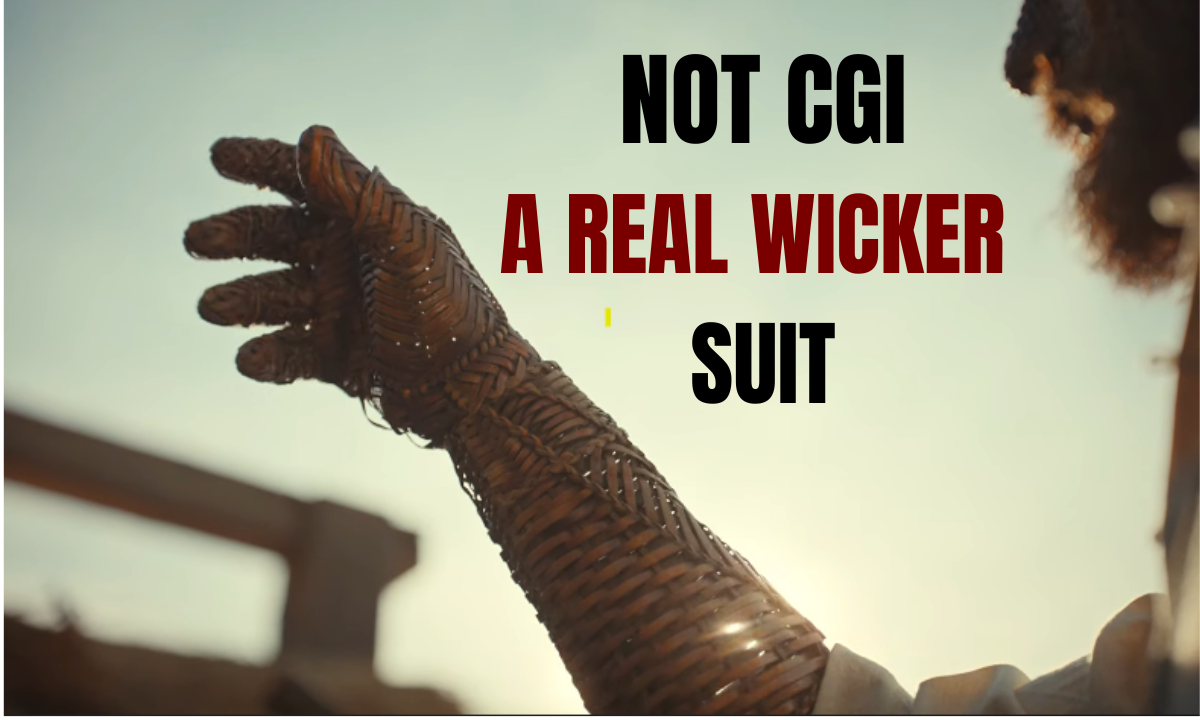
In Wicker, Alexander Skarsgård doesn’t just play an unusual romantic lead—he becomes one. Cast as a husband woven from willow branches, the actor disappears beneath one of the film’s most remarkable practical creations: the Alexander Skarsgård Wicker Suit.
While many modern fantasy films would rely heavily on CGI, directors Alex Huston Fischer and Eleanor Wilson took a different approach. According to Entertainment Weekly, they wanted the character to exist as a real physical presence on set, allowing the cast and camera to interact with something tangible rather than a digital stand-in.
That decision led them to New Zealand’s renowned Weta Workshop, whose artists transformed an imaginative concept into a believable living character through handcrafted practical effects.
Wicker Suit at a Glance
Film: Wicker
Actor: Alexander Skarsgård
Built by: Weta Workshop
Prosthetics Lead: Joe Dunckley
Materials: Hand-woven willow elements and custom silicone prosthetics
Approach: Practical effects with limited digital enhancement
How Weta Workshop Built the Alexander Skarsgård Wicker Suit
Designing a believable man made entirely of woven willow presented an unusual challenge. The costume needed to look handcrafted and organic while preserving the subtle facial expressions that make a performance feel human.
To solve that problem, Weta Workshop, under prosthetic designer Joe Dunckley, developed a hybrid practical suit that combined real woven materials with custom silicone prosthetics.
Instead of hiding Skarsgård’s face beneath a rigid shell, the prosthetic pieces were carefully integrated into the basket-like design so his expressions could remain visible throughout the film.
According to Entertainment Weekly, the filmmakers deliberately avoided making the character feel like a digital effect. Their goal was to create a figure that actors could physically interact with and that cinematographer Lol Crawley could photograph using natural light rather than relying on extensive visual effects later in post-production.
That choice becomes obvious on screen. Candlelight catches the woven texture differently from smooth synthetic materials, creating tiny highlights and shadows that constantly shift as Skarsgård moves. The result feels tactile and surprisingly lifelike, helping audiences accept an inherently fantastical premise.
The production also benefited from close collaboration across departments. Weta Workshop worked alongside the film’s production and costume designers to ensure the suit complemented the rustic world of Wicker, making the character appear as though he had genuinely been crafted from the landscape itself rather than assembled in a workshop.
Also Read: Who Designed Johnny Depp’s Ebenezer Scrooge Prosthetics and Makeup? The Transformation Explained
Why the Practical Suit Works Better Than CGI
The Alexander Skarsgård Wicker Suit succeeds because it never competes with the performance—it enhances it.
Rather than asking Olivia Colman to imagine a digital character that would be added months later, the production placed a fully realized practical costume directly in front of the camera. That gave every interaction a sense of weight and authenticity, from quiet conversations to simple moments of physical contact.
Practical effects also allowed the cinematography to capture genuine textures. Willow fibers catch natural light differently than computer-generated surfaces, while the handcrafted imperfections make the character feel less artificial and more emotionally believable.
For the filmmakers, practical craftsmanship wasn’t simply an aesthetic decision, it was central to making the story’s unconventional romance feel genuine.
How the Wicker Suit Shaped Alexander Skarsgård’s Performance
Playing a man woven from willow required more than simply wearing an elaborate costume. The physical suit became part of Alexander Skarsgård’s performance, influencing how he moved, reacted, and connected with the other characters.
Unlike many of his previous roles—which often lean into intensity or physical menace—the character in Wicker demanded warmth, innocence, and quiet vulnerability. Instead of relying on visual effects to create those qualities later, the practical suit allowed Skarsgård to embody them during filming.
In an interview with Entertainment Weekly, the actor joked about finally achieving an unusual career ambition:
“Most male actors dream of playing Hamlet at some point in their career. I never did. My dream was always to have nipples made out of wicker.”
— Alexander Skarsgård
While humorous, the comment reflects just how unconventional the role was. Every scene depended on making audiences believe that a man crafted from woven willow could feel gentle, expressive, and emotionally real.
Because the costume existed physically on set, Olivia Colman wasn’t performing opposite a green-screen placeholder or motion-capture performer. She could touch the woven surface, lean against it, and react naturally to a character who occupied the same space. That tangible interaction helps sell the film’s fairy-tale romance in a way that extensive CGI often struggles to achieve.
Why the Wicker Suit Looks So Convincing
One of the smartest design decisions was ensuring the costume never concealed Skarsgård’s performance.
Rather than covering his face with rigid materials, Weta Workshop designed flexible prosthetic elements that preserved subtle eyebrow movement, eye contact, and facial expressions. The handcrafted willow texture then blended seamlessly with those prosthetics, creating the illusion that the character was genuinely woven from natural materials.
This balance between craftsmanship and performance is what makes the Alexander Skarsgård Wicker Suit so memorable. Viewers aren’t simply admiring an impressive costume—they’re connecting with a believable character whose emotions remain visible beneath every woven strand.
A Masterclass in Practical Costume Design
The Alexander Skarsgård Wicker Suit is more than an eye-catching costume. it’s the emotional foundation of Wicker. By choosing handcrafted practical effects over an entirely digital character, the filmmakers created a fantasy figure that feels remarkably tangible and human.
Weta Workshop’s blend of woven materials, expressive prosthetics, and meticulous craftsmanship demonstrates why practical effects continue to hold a unique place in modern filmmaking. Instead of overshadowing Skarsgård’s performance, the suit amplifies it, allowing every glance, smile, and quiet moment to resonate with surprising authenticity.
In an era where CGI often dominates fantasy cinema, Wicker serves as a reminder that sometimes the most convincing movie magic begins with skilled artisans, real materials, and a performer willing to disappear beneath an extraordinary piece of craftsmanship.
Frequently Asked Questions
How was Alexander Skarsgård’s wicker suit made?
The suit was built by Weta Workshop using a combination of hand-woven willow elements and custom silicone prosthetics. This hybrid design allowed the costume to retain a handcrafted appearance while preserving Skarsgård’s facial expressions.
Was the wicker suit real or CGI?
The character was primarily created using a practical costume rather than a fully digital effect. According to Entertainment Weekly, the filmmakers wanted a real physical presence on set so actors could interact naturally, with only limited digital enhancement used where necessary.
Who created the practical effects for Wicker?
The practical effects were developed by Weta Workshop, with prosthetic designer Joe Dunckley leading the creation of the wicker suit. The team collaborated closely with the film’s production and costume departments to ensure the character blended naturally into Wicker’s handcrafted visual style.
Sources:
Entertainment Weekly interview with the cast and filmmakers of Wicker
Official production information for Wicker
Weta Workshop production credits